Research
CJC-1295 + Ipamorelin in South Africa
By BIOVARA · · 11 min read
Key takeaways
- CJC-1295 and Ipamorelin are two of the most searched research peptides in South Africa, and they are very often discussed together.
- CJC-1295 and Ipamorelin are two of the most searched research peptides in South Africa, and they are very often discussed together. One is a modified fragment of growth hormone-releasing hormone (GHRH); the other is a small synthetic peptide that acts at a different receptor, the ghrelin or growth hormone secretagogue receptor. If you have been searching for "CJC-1295 Ipamorelin South Africa", this guide covers what each compound is, how their structures differ, what published laboratory research has looked at, the formats available, and how to store and document them properly
- CJC-1295 without DAC (also called Modified GRF 1-29 or Mod GRF 1-29): the 29-amino-acid peptide with the four substitutions and no extra chemical group. This is the version Biovara supplies. CJC-1295 with DAC: the same peptide with a "drug affinity complex", a reactive linker designed to bind albumin in serum. It has a different molecular formula and a much higher molecular weight.
- CJC-1295 (no DAC) specifications The data below match the PubChem record for this sequence (CID 56841945) and the specifications on our product pages. Tyr-D-Ala-Asp-Ala-Ile-Phe-Thr-Gln-Ser-Tyr-Arg-Lys-Val-Leu-Ala-Gln-Leu-Ser-Ala-Arg-Lys-Leu-Leu-Gln-Asp-Ile-Leu-Ser-Arg-NH2 Length: 29 amino acids, C-terminal amide Substitutions compared with native GHRH(1–29): D-alanine at position 2, glutamine at position 8, alanine at position 15 and leucine at position 27 Molecular formula: C152H252N44O42 Molecular weight: 3367.9 g/mol CAS number: 863288-34-0 The D-alanine at position 2 is the key change. Native GHRH fragments are cleaved between positions 2 and 3 by the enzyme dipeptidyl peptidase-4, and swapping in the D-form of alanine is the classic way to block that cut. The other three substitutions target sites prone to oxidation, rearrangement or other enzymatic cleavage.
- Why are CJC-1295 and Ipamorelin studied together? The two compounds act on two different receptors in the same signalling system. CJC-1295 is a GHRH-receptor agonist, while Ipamorelin is a GHS-R1a (ghrelin receptor) agonist. In laboratory pharmacology, GHRH-pathway and ghrelin-pathway signalling are studied as separate inputs that can be compared or combined, which is why many research groups look at a GHRH analogue and a secretagogue side by side. A pre-mixed blend simply supplies both compounds in one vial or pen, with the component ratio stated on the batch label.
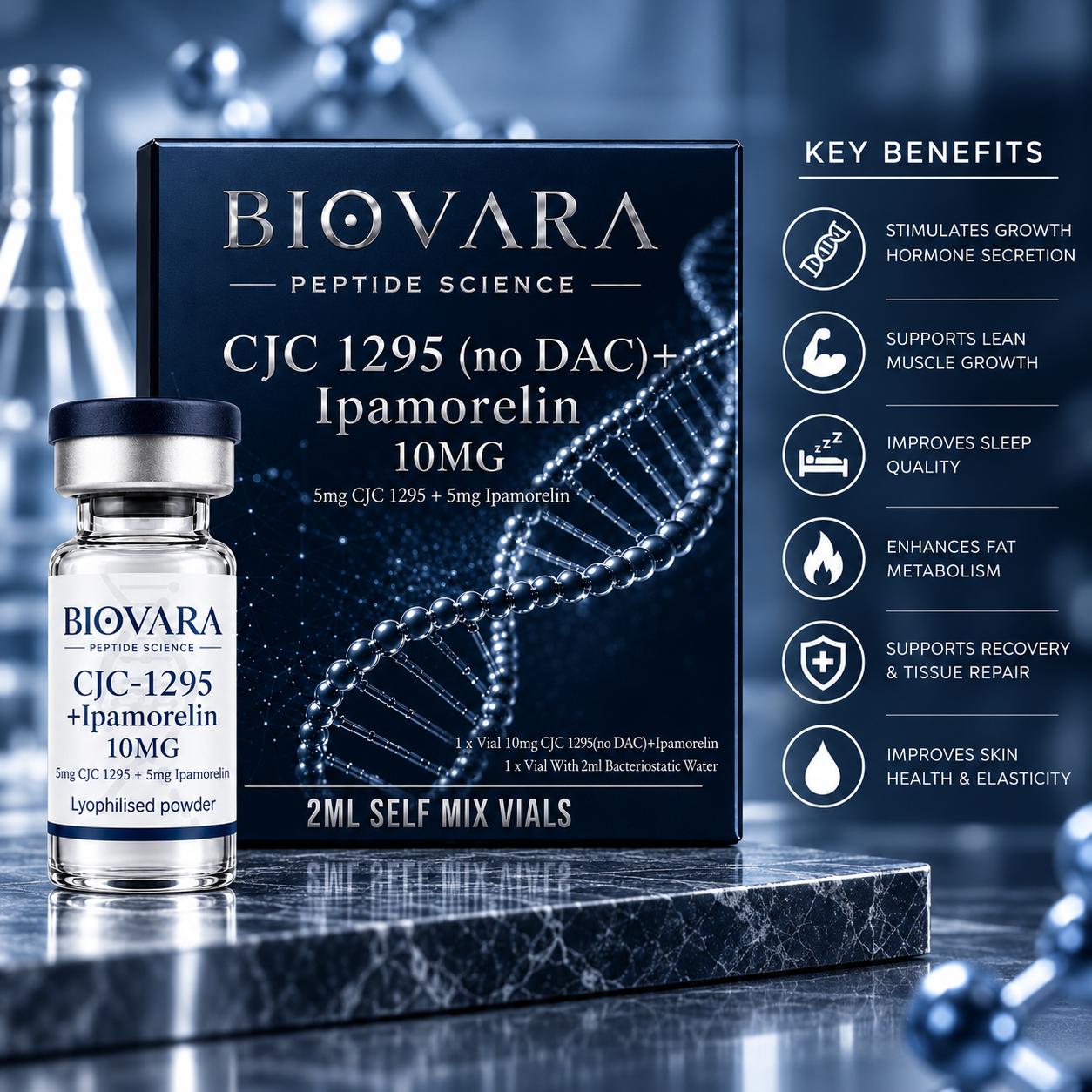
CJC-1295 + Ipamorelin in South Africa: Structure, Research and Formats.CJC-1295 and Ipamorelin are two of the most searched research peptides in South Africa, and they are very often discussed together. CJC-1295 and Ipamorelin are two of the most searched research peptides in South Africa, and they are very often discussed together. One is a modified fragment of growth hormone-releasing hormone (GHRH); the other is a small synthetic peptide that acts at a different receptor, the ghrelin or growth hormone secretagogue receptor. If you have been searching for "CJC-1295 Ipamorelin South Africa", this guide covers what each compound is, how their structures differ, what published laboratory research has looked at, the formats available, and how to store and document them properly What is CJC-1295? CJC-1295 is a synthetic 29-amino-acid peptide based on the first 29 residues of human GHRH, often written GHRH(1–29) or GRF(1–29). That short fragment is the part of the native hormone that binds the GHRH receptor, but on its own it is broken down very quickly by enzymes. CJC-1295 carries four amino acid substitutions designed to make it more resistant to that breakdown. There are two versions in the literature, and it is worth knowing which one you are working with: CJC-1295 without DAC (also called Modified GRF 1-29 or Mod GRF 1-29): the 29-amino-acid peptide with the four substitutions and no extra chemical group. This is the version Biovara supplies. CJC-1295 with DAC: the same peptide with a "drug affinity complex", a reactive linker designed to bind albumin in serum. It has a different molecular formula and a much higher molecular weight. CJC-1295 (no DAC) specifications The data below match the PubChem record for this sequence (CID 56841945) and the specifications on our product pages. Tyr-D-Ala-Asp-Ala-Ile-Phe-Thr-Gln-Ser-Tyr-Arg-Lys-Val-Leu-Ala-Gln-Leu-Ser-Ala-Arg-Lys-Leu-Leu-Gln-Asp-Ile-Leu-Ser-Arg-NH2 Length: 29 amino acids, C-terminal amide Substitutions compared with native GHRH(1–29): D-alanine at position 2, glutamine at position 8, alanine at position 15 and leucine at position 27 Molecular formula: C152H252N44O42 Molecular weight: 3367.9 g/mol CAS number: 863288-34-0 The D-alanine at position 2 is the key change. Native GHRH fragments are cleaved between positions 2 and 3 by the enzyme dipeptidyl peptidase-4, and swapping in the D-form of alanine is the classic way to block that cut. The other three substitutions target sites prone to oxidation, rearrangement or other enzymatic cleavage. What is Ipamorelin? Ipamorelin is a synthetic pentapeptide (five residues) developed at Novo Nordisk in the 1990s. It belongs to the growth hormone secretagogue (GHS) family and acts at the GHS-R1a receptor, the same receptor that the hormone ghrelin binds. It was designed as a smaller, more selective successor to earlier secretagogues such as GHRP-6. Ipamorelin specifications The data below match the PubChem record for Ipamorelin (CID 9831659) and our product pages. Aib-His-D-2-Nal-D-Phe-Lys-NH2 Length: 5 residues, C-terminal amide Unusual residues: Aib (2-aminoisobutyric acid) at the N-terminus and D-2-Nal (D-2-naphthylalanine), both non-standard amino acids Molecular formula: C38H49N9O5 Molecular weight: 711.9 g/mol CAS number: 170851-70-4 Because Ipamorelin contains two D-amino acids and two non-standard residues, its identity is confirmed by mass spectrometry rather than by comparison with any natural sequence. That is one reason the COA matters so much for this compound. Why are CJC-1295 and Ipamorelin studied together? The two compounds act on two different receptors in the same signalling system. CJC-1295 is a GHRH-receptor agonist, while Ipamorelin is a GHS-R1a (ghrelin receptor) agonist. In laboratory pharmacology, GHRH-pathway and ghrelin-pathway signalling are studied as separate inputs that can be compared or combined, which is why many research groups look at a GHRH analogue and a secretagogue side by side. A pre-mixed blend simply supplies both compounds in one vial or pen, with the component ratio stated on the batch label. What has been studied in the lab? The work summarised below is preclinical research in animal models and isolated cells. It is described only as scientific background, not as evidence of any effect outside a laboratory setting. CJC-1295 and GHRH-receptor research A 2005 paper in Endocrinology (Jetté and colleagues) studied a series of GRF(1–29) analogues designed to bind albumin and examined their activity at the GRF receptor in the rat anterior pituitary. It is the paper that identified CJC-1295 as a long-lasting GRF analogue. Note that this work concerned the DAC (albumin-binding) design, which is a different molecule from the no-DAC peptide described above. Ipamorelin and receptor selectivity The first full description of Ipamorelin was published by Raun and colleagues in the European Journal of Endocrinology in 1998. Working with primary pituitary cells and animal models, the authors compared Ipamorelin with earlier secretagogues and reported that it showed a more selective profile, which is why the paper's title calls it "the first selective growth hormone secretagogue". A 1999 rat study by Johansen and colleagues in Growth Hormone & IGF Research examined the compound further in laboratory animals. Formats available in South Africa Biovara supplies these compounds individually and as a blend, in two formats: CJC-1295 + Ipamorelin vial: lyophilised blend, 10 mg and 20 mg total peptide CJC-1295 + Ipamorelin Peptide Pen: ready-made solution, 10 mg and 20 mg CJC-1295 (no DAC) vial: 5 mg and 10 mg Ipamorelin vial: 10 mg Single-compound pens are also listed in our pre-filled peptide pens range, and every lyophilised format is in the peptide vials collection. For a side-by-side look at the two formats, see our guide to peptide pens vs vials. Vials Biovara Lyophilised (freeze-dried) vials offer the longest shelf life and travel well at ambient temperature during normal courier transit. Every Biovara peptide vial ships with a 10 ml Genetek USP-grade bacteriostatic water and reconstitution kit included, so you don't need to order a separate solution. Pre-filled pens Biovara Pens are supplied as a ready-made solution, made to order and dispatched by overnight cold-chain courier. They must stay refrigerated. If reliable overnight delivery isn't available in your area, the vial version is the better choice.
Frequently asked questions
- What is CJC+ Ipamorelin?
- What is CJC-1295? CJC-1295 is a synthetic 29-amino-acid peptide based on the first 29 residues of human GHRH, often written GHRH(1–29) or GRF(1–29). That short fragment is the part of the native hormone that binds the GHRH receptor, but on its own it is broken down very quickly by enzymes. CJC-1295 carries four amino acid substitutions designed to make it more resistant to that breakdown. There are two versions in the literature, and it is worth knowing which one you are working with: CJC-1295 without DAC (also called Modified GRF 1-29 or Mod GRF 1-29): the 29-amino-acid peptide with the four substitutions and no extra chemical group. This is the version Biovara supplies. CJC-1295 with DAC: the same peptide with a "drug affinity complex", a reactive linker designed to bind albumin in serum. It has a different molecular formula and a much higher molecular weight.
- What is CJC?
- CJC-1295 (no DAC) specifications The data below match the PubChem record for this sequence (CID 56841945) and the specifications on our product pages. Tyr-D-Ala-Asp-Ala-Ile-Phe-Thr-Gln-Ser-Tyr-Arg-Lys-Val-Leu-Ala-Gln-Leu-Ser-Ala-Arg-Lys-Leu-Leu-Gln-Asp-Ile-Leu-Ser-Arg-NH2 Length: 29 amino acids, C-terminal amide Substitutions compared with native GHRH(1–29): D-alanine at position 2, glutamine at position 8, alanine at position 15 and leucine at position 27 Molecular formula: C152H252N44O42 Molecular weight: 3367.9 g/mol CAS number: 863288-34-0 The D-alanine at position 2 is the key change. Native GHRH fragments are cleaved between positions 2 and 3 by the enzyme dipeptidyl peptidase-4, and swapping in the D-form of alanine is the classic way to block that cut. The other three substitutions target sites prone to oxidation, rearrangement or other enzymatic cleavage.
- Why use CJC+Ipamorelin?
- Why are CJC-1295 and Ipamorelin studied together? The two compounds act on two different receptors in the same signalling system. CJC-1295 is a GHRH-receptor agonist, while Ipamorelin is a GHS-R1a (ghrelin receptor) agonist. In laboratory pharmacology, GHRH-pathway and ghrelin-pathway signalling are studied as separate inputs that can be compared or combined, which is why many research groups look at a GHRH analogue and a secretagogue side by side. A pre-mixed blend simply supplies both compounds in one vial or pen, with the component ratio stated on the batch label.
- What CJC+Ipamorelin is available in South Africa?
- What has been studied in the lab? The work summarized below is preclinical research in animal models and isolated cells. It is described only as scientific background, not as evidence of any effect outside a laboratory setting. CJC-1295 and GHRH-receptor research A 2005 paper in Endocrinology (Jetté and colleagues) studied a series of GRF(1–29) analogues designed to bind albumin and examined their activity at the GRF receptor in the rat anterior pituitary. It is the paper that identified CJC-1295 as a long-lasting GRF analogue. Note that this work concerned the DAC (albumin-binding) design, which is a different molecule from the no-DAC peptide described above. Ipamorelin and receptor selectivity The first full description of Ipamorelin was published by Raun and colleagues in the European Journal of Endocrinology in 1998. Working with primary pituitary cells and animal models, the authors compared Ipamorelin with earlier secretagogues and reported that it showed a more selective profile, which is why the paper's title calls it "the first selective growth hormone secretagogue". A 1999 rat study by Johansen and colleagues in Growth Hormone & IGF Research examined the compound further in laboratory animals. Formats available in South Africa Biovara supplies these compounds individually and as a blend, in two formats: CJC-1295 + Ipamorelin vial: lyophilised blend, 10 mg and 20 mg total peptide CJC-1295 + Ipamorelin Peptide Pen: ready-made solution, 10 mg and 20 mg CJC-1295 (no DAC) vial: 5 mg and 10 mg Ipamorelin vial: 10 mg Single-compound pens are also listed in our pre-filled peptide pens range, and every lyophilised format is in the peptide vials collection. For a side-by-side look at the two formats, see our guide to peptide pens vs vials. Vials Lyophilised (freeze-dried) vials offer the longest shelf life and travel well at ambient temperature during normal courier transit. Every Biovara peptide vial ships with a 10 ml Genetek USP-grade bacteriostatic water and reconstitution kit included, so you don't need to order a separate solution. Pre-filled pens Biovara Pens are supplied as a ready-made solution, made to order and dispatched by overnight cold-chain courier. They must stay refrigerated. If reliable overnight delivery isn't available in your area, the vial version is the better choice.
For research purposes only. Not for human consumption. You must be 18 or older to purchase. Nothing in this article is medical advice.